

Ask ten small business owners what quality means and you will get ten different answers. Most of them will describe their own standards, their own attention to detail, or their own pride in what they produce. Very few will describe what their customers actually experience.
That gap is the problem.
Your personal definition of quality is not irrelevant. But it is incomplete. And in many cases, it is quietly working against you because it causes you to optimize for the wrong things, miss the complaints that matter most, and measure your work against a standard your customer never agreed to.
This article challenges four misconceptions about product quality that show up consistently in small businesses. Not to be contrarian, but because getting the definition right is where every other quality improvement effort has to start. You can’t build better processes, tighter checklists, or more effective inspections around a definition of quality that does not match what your customer is actually evaluating.
Start here. Get the definition right. Everything else becomes easier.
Table of contents
- Misconception #1 – Quality Means Your Best Work
- Misconception #2 – Quality Lives in the Product Itself
- Misconception #3 – Quality Means Expensive
- Misconception #4 – You Know Quality When You See It
- So What Does Product Quality Actually Mean?
- How to Define Quality for Your Product Right Now
- The Definition Comes First
Misconception #1 – Quality Means Your Best Work
This is the most widespread misconception in small business, and it’s completely understandable. You built your business on caring about what you do. You take pride in the craft. There’s no doubt you work harder than most people would on the same job. Surely that translates to quality.

It does not.
Effort and quality are related but they are not the same thing. A product made with tremendous care and skill can still fail to meet the needs, expectations, or real-world use case of the person who bought it. When that happens, the customer’s experience of quality is poor regardless of how good the work actually is.
Consider a small furniture maker who produces beautifully crafted wooden chairs using premium materials and traditional joinery techniques. By any craftsman’s standard, the work is exceptional. But the chairs ship as flat-pack components with no assembly instructions included because the maker assumes the process is intuitive. Most customers can’t figure out how to put them together without calling for help. Some assemble them incorrectly and damage the wood in the process.
The craftsmanship is real. The customer’s experience of quality is poor. Both things are true at the same time.
Your standards matter as a floor. They define the minimum your product should be. The customer’s expectations set the ceiling. Quality means meeting both, and you won’t know whether you’re meeting the ceiling without understanding what your customer actually expects from the product they bought.
Misconception #2 – Quality Lives in the Product Itself
The second misconception is that quality is a property of the object or deliverable. The product either meets a standard or it does not. Get the thing right and quality is handled.

Customers do not experience your product in isolation. They experience the entire journey from the moment they place an order to the moment they are using what they received. Packaging, delivery speed, presentation, instructions, setup experience, and after-sale support are all part of what they call quality. None of those things are the product itself.
There is also an important distinction between actual quality and perceived quality. A technically superior product that arrives in a battered box, is difficult to open, comes with no documentation, and has no obvious way to get help if something goes wrong will be perceived as lower quality than a functionally simpler product that arrives well-presented, is easy to start using immediately, and comes with a clear point of contact if questions come up.
This is not about fooling customers with good packaging. It’s about recognizing that the product experience and the product itself are inseparable in the customer’s mind.
Picture two small candle companies with nearly identical products, similar scents, similar burn times, similar wax quality. The first ships in generic brown mailer boxes with no tissue paper and no instructions. The second ships in branded boxes with tissue paper, a card explaining the best way to burn the candle for maximum life, and a simple thank-you note. The customer of the second company perceives a higher quality product before they’ve lit a single wick. That perception shapes the review they leave, whether they buy again, and whether they recommend the brand.
Quality is not just what you make. It is the entire experience of receiving and using what you make. Build your quality standards around the full journey, not just the object at the center of it.
Misconception #3 – Quality Means Expensive
This misconception cuts in two directions and both versions are wrong.
The first version says that producing a quality product requires premium materials, premium processes, and premium pricing. If you are not operating at the high end of your market, genuine quality is out of reach.
The second version says that delivering quality at a lower price point is impossible. That budget-conscious buyers should expect lower quality and that competing on price means accepting quality trade-offs.

Both versions confuse quality with price. Quality means fit for purpose. A product is high quality when it reliably does what it is supposed to do for the specific customer who bought it at the price they paid for it. Pricing does not change that standard. It only changes the specification.
A twelve-dollar chef’s knife and a hundred-and-twenty-dollar chef’s knife can both be high-quality products. The twelve-dollar knife is high quality if it holds an edge well enough for a home cook who uses it a few times a week and does not break within a reasonable period of use. The hundred-and-twenty-dollar knife is poor quality if the handle separates from the blade after three months in a professional kitchen.
Quality is always relative to expectation and use case. A small business owner who sells at a moderate price point is not excused from quality. They are responsible for defining what quality means at that price point and delivering it consistently. That is a different specification than the premium product, not a lower standard.
It’s important to not measure your product against a standard that belongs to a different market. Define quality in terms of what your specific customer needs from your specific product at your specific price. Meet that standard every time. That is quality.
Misconception #4 – You Know Quality When You See It
This one is the most dangerous of the four because it feels the most reasonable.
Let’s say you’ve been working in your field long enough to recognize good work. You have a professional eye. You can look at your product and tell whether it meets the standard. Your gut is reliable. Why would you need anything more formal than that?
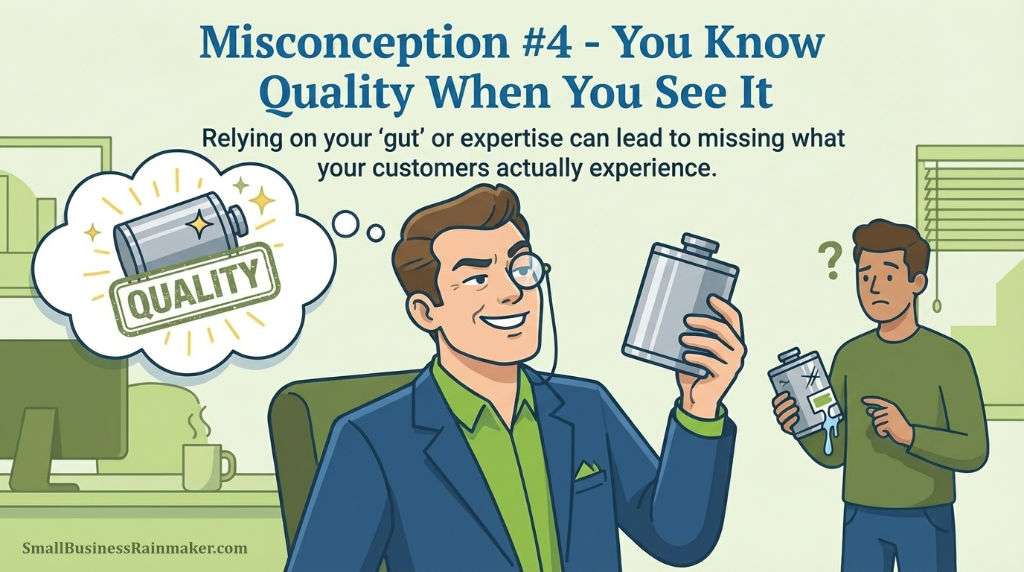
Your gut is calibrated to your own experience, your own expertise, and your own perspective. As valuable as that is, it’s still not your customer’s experience. The longer you work in a field, the harder it is to see your product through a first-time user’s eyes. You stop noticing the things that feel basic or obvious to you because they stopped being basic or obvious to you years ago. Those are often exactly the things your customer notices most.
Owners who rely on gut-based quality assessment systematically miss the things that matter most to new customers because those things do not register as quality issues to someone with expertise. They look like non-issues. Minor details. Things nobody would really care about.
Consider a small food producer who has made the same hot sauce for five years. They know exactly what it should taste like, look like, and smell like after years of refining the recipe. But they have never noticed that the label starts to peel at the lower corner after the bottle gets wet from condensation in the refrigerator. They store their own bottles differently. They use them quickly. The peeling never shows up in their experience of the product. It shows up in customer reviews consistently, and the producer reads those reviews and still does not register it as a quality issue because the sauce itself is exactly right.
Quality assessment requires stepping outside your own perspective deliberately and regularly. Your eyes are not enough. We all need our customer’s eyes, their use patterns, and their expectations in the room with us when you evaluate that which is being produced.
So What Does Product Quality Actually Mean?
With the misconceptions cleared, here is a working definition that is practical and useful for a small company.
Quality has three components. Every small business owner needs to define all three explicitly for their specific product before they can meaningfully improve quality or build systems to protect it.
1 – Fitness for purpose
Does the product reliably do what it is supposed to do for the customer who bought it, under the conditions they will actually use it in? Not ideal conditions in your production environment. Real conditions in a real customer’s hands. This is the core of what quality means and everything else builds on it.
2 – Consistency
Does the product deliver that result every time, not just when conditions are perfect or the most experienced person on your team handles it? A product that meets your standard eight times out of ten is not a quality product. It is an inconsistent one. Consistency is what separates a good product from a reliable business.
3 – Meeting customer expectations
Understand what your customer expects and make sure the product delivers that. This requires asking customers directly rather than assuming you already know. The answers are often different from what you expect, and the gap between your assumption and their answer is where quality problems hide.
These three components are the definition that drives everything else. It’s impossible to build a meaningful quality checklist, a reliable inspection process, or an effective testing protocol without first answering all three questions for your specific product. Trying to improve quality without a clear definition is like trying to give someone directions without knowing where they are starting from.
For service businesses, the same three components apply. Fitness for purpose means the service delivers the outcome the client hired you for. Consistency means it delivers that outcome the same way every time regardless of who on your team does the work. Meeting customer expectations means understanding what the client values beyond just the outcome itself, including how you communicate, how you handle problems, and what the experience of working with you feels like.
How to Define Quality for Your Product Right Now
The definition above is only useful if you translate it into specific terms for your specific product. Here is how to do that in three steps.

1 – Ask your best customers what they value most.
Not what they like about the product in general, but what they would notice if it changed or went away. What would make them switch to a competitor? What do they rely on most? Their answers define quality from the only perspective that actually drives purchasing decisions. You may be surprised by what they say. That surprise is valuable information.
2 – Write your own quality standards in observable, measurable terms.
Not the product should look professional but the stitching should be uniform with no loose threads and no spacing wider than two millimeters. Not the delivery should be timely but orders placed before noon ship the same business day. Vague standards produce vague and inconsistent results. Specific standards give everyone on your team a target they can actually aim at.
3 – Compare your definition with what your reviews and complaints are actually telling you.
Pull your last twenty customer reviews or complaints. What do they mention most? What surprises you? The gap between what you think quality means and what customers are saying about their experience is the most honest quality assessment you have access to. It costs nothing and it is already sitting in your inbox or your review platform waiting to be read as data rather than as individual feedback.
Once you have a clear, customer-informed, measurable definition of quality for your product, you have something to build on. Checklists, testing protocols, and inspection standards all become more effective because they have a specific target to aim at instead of a general sense of doing good work.
The Definition Comes First
Quality is not your best effort. It is not a property of the product in isolation. It is not determined by price point, and it is not something your professional eye can assess reliably on its own.
Quality is fitness for purpose delivered consistently in a way that meets the expectations of the actual customer. That definition is simple. Applying it honestly to your own product requires setting aside the assumptions that feel most natural and replacing them with what your customers are actually telling you.
Get the definition right and every other quality improvement effort becomes more focused and more effective. Get it wrong and you can build the most thorough checklist in your industry and still miss the things your customers care about most.
This is where quality improvement starts. Not with a new process or a new tool, but with a clear, honest, customer-informed answer to the question you thought you already knew.
Once you have that definition, the next step is building the processes that produce it reliably every time. That is what Business Process Management for Small Businesses is designed to help you do. It gives you a practical framework for turning a clear quality standard into a documented, repeatable system that delivers consistent results without depending on memory, heroic effort, or the right person being on shift that day.


