You are good at what you do. Customers generally say so. But every so often something slips through that should not have. A step gets skipped. A detail gets missed. A deliverable goes out that does not quite meet your own standards.
The problem is rarely skill. Most small business owners and their teams know exactly what good work looks like. The problem is consistency. Doing things right most of the time is not enough to build a reputation that grows. Consistent quality is what earns repeat business, referrals, and reviews worth sharing.
The simplest tool for building consistent quality is also the most underused one in small business: the quality checklist. You don’t need a QA department to build one. You don’t need specialized software or a consultant. You need a clear picture of how good work gets done, written down in a format anyone on your team can follow.
A checklist does not replace your expertise. It protects it.
Why Checklists Work Even for Experienced Owners
The most common pushback against checklists goes something like this, “I’ve been doing this for ten years and don’t need a list to tell me how to do my job.”
That is a fair point, but it’s also beside the point. Checklists are not for the things you might forget because you lack knowledge. They’re for the things that slip when you are busy, distracted, rushing to meet a deadline, or handing work off to someone else for the first time.
Surgeons use checklists before every procedure. Pilots run through pre-flight checks before every takeoff. Not because they forgot how to do their jobs, but because high-stakes consistency requires a system. Ask a captain with 30 years experience and they’ll tell you they use a checklist just as they did on their very first flights. Memory alone is not enough when the stakes are high and the workload is real.
Your business works the same way. A quality checklist is not a sign that you or your team cannot be trusted. It’s a standard you define once, apply every time, and hand off to anyone who joins your team without losing quality in the process.
The Two Types of Quality Checklists Every Small Business Needs
Not all checklists serve the same purpose. There are two distinct types, and most small businesses only use an informal version of one of them.
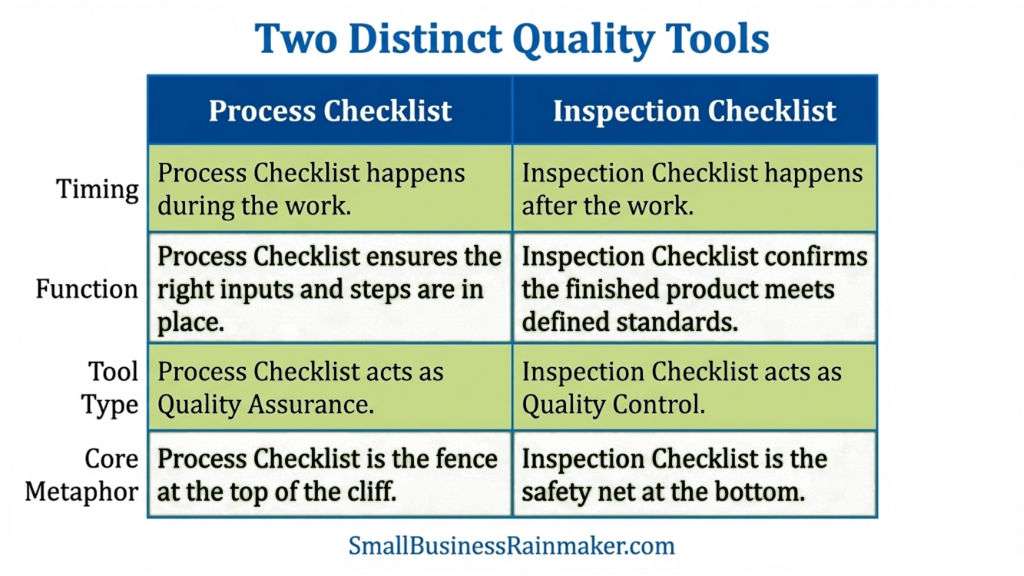
The first is a process checklist. This covers the steps to follow while the work is being done. It’s your quality assurance tool. It ensures the right inputs, materials, approvals, and steps are in place before and during production or delivery. A process checklist catches problems before they get baked into the final product.
The second is an inspection checklist. This covers the criteria you verify after the work is done. It’s your quality control tool. It confirms that the finished product or service meets your defined standards before it reaches the customer.
Most businesses have an informal version of the inspection checklist. Someone gives the work a quick look before it ships. What they almost never have is a documented process checklist that prevents the problems showing up at that final review.
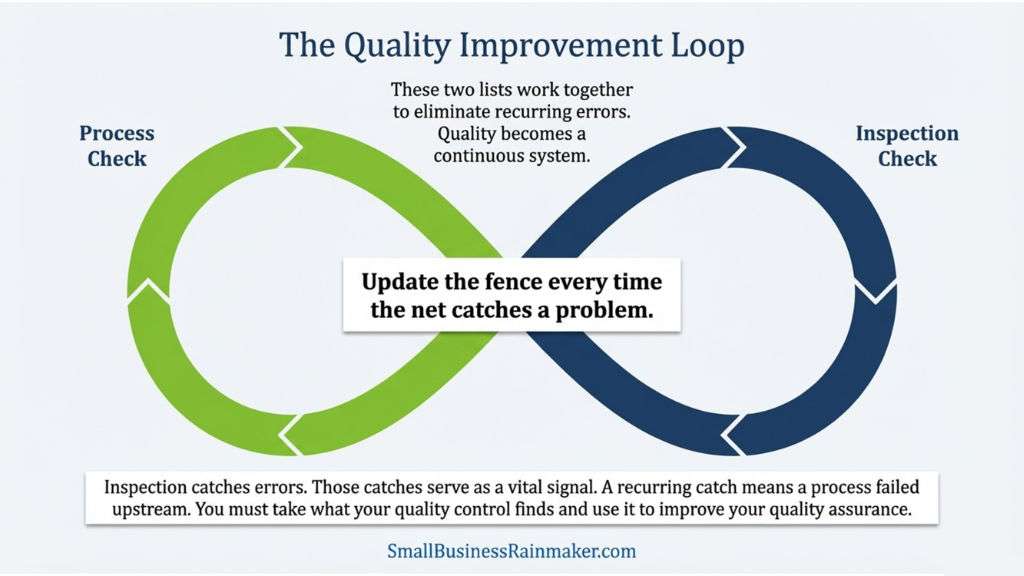
Think of it this way. The inspection checklist is the safety net at the bottom of the cliff. The process checklist is the fence at the top. Both serve a purpose. But the fence does a lot more to prevent problems.
You need both. And for most small businesses, despite feeling a bit counter-intuitive, the process checklist is the one to build first.
How to Build Your Process Checklist
Start simple. The goal of your first checklist is not to document every possible scenario. It’s to capture the steps that define how your best work actually gets done.
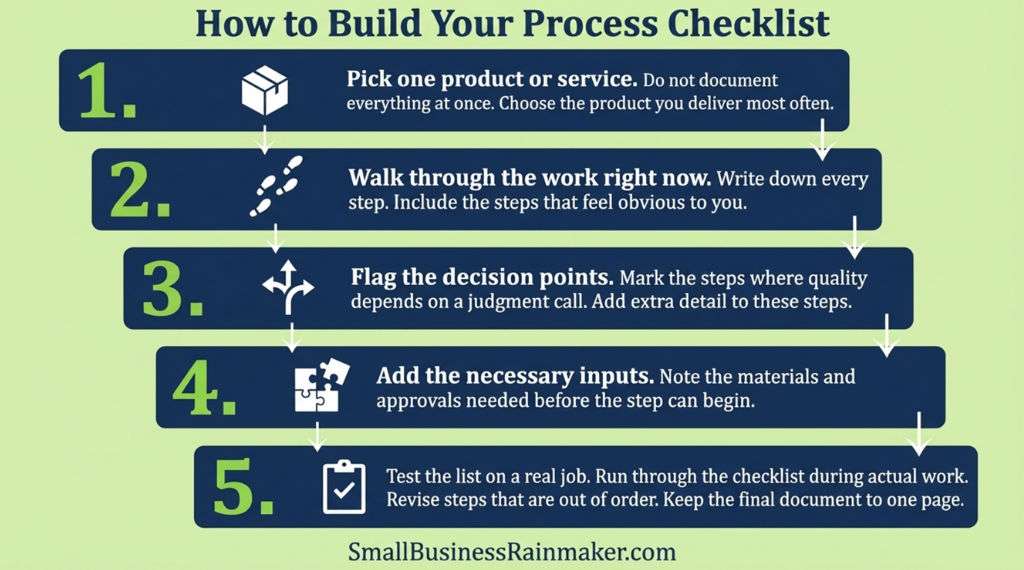
Follow these steps to create the process checklist.
- Pick one product or service to start.
Don’t try to document everything at once. Choose the product or service you deliver most often, or the one where errors cost you the most in time, rework, or reputation. Start there and build out from a single win. - Walk through the work as if you are doing it right now.
Write down every step, including the ones that feel obvious. What is obvious to you at your best is not obvious to a new team member or a distracted version of yourself on a Friday afternoon when three other things are competing for your attention. If it matters to the outcome, it goes on the list. - Flag the decision points.
Where do things tend to go wrong? Where does quality depend on a judgment call or a variable that changes job to job? Mark those steps. They need more detail than the straightforward ones. - Add the inputs.
For each step, note what materials, information, tools, or approvals need to be in place before that step can begin. This is where most quality problems start. Work moves forward before it is actually ready to. - Test it on a real job.
Run through the checklist during actual work, not just in your head afterward. You will find steps that are out of order, steps you forgot entirely, and steps that made sense on paper but don’t match how the work actually flows. Revise and repeat.
One practical note on length: a process checklist should fit on one page or less. If it runs longer, break it into sub-checklists by phase or stage. A checklist no one uses because it is overwhelming is worse than no checklist at all.
How to Build Your Inspection Checklist
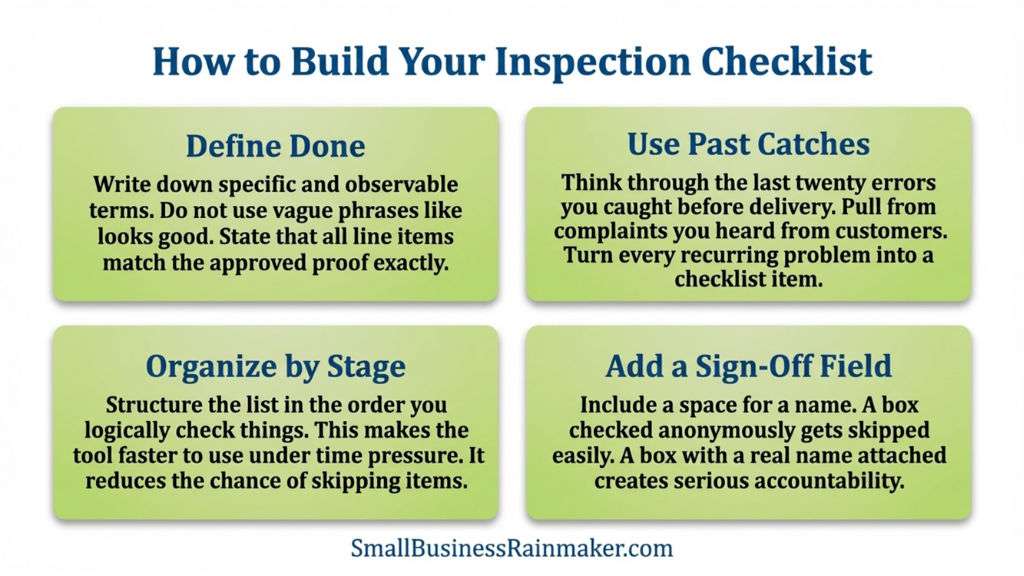
Your inspection checklist is your last line of defense before work reaches the customer. Build it with that in mind.
- Start with your definition of done.
What does a completed, acceptable product or service actually look like? Write it down in specific, observable terms. Not “looks good” but “all seams are straight and free of loose threads.” Not “order is correct” but “all line items match the approved proof and quantities match the purchase order.” Vague standards produce vague results. - Pull from your past catches and complaints.
Think back through the last 10 to 20 errors you caught before delivery, or the complaints you heard from customers after the fact. Those are your inspection criteria. Every recurring problem is a checklist item waiting to be written down. - Organize by stage, not by importance.
Structure the checklist in the order you would logically check things. This makes it faster to use under real-world time pressure and reduces the chance of jumping around and missing something. - Include a sign-off field.
Someone’s name goes on the completed checklist. Whether it is the owner or a team member, attaching accountability to the review changes how seriously it gets taken. A box you can check anonymously is easy to skip. A box with your name on it is not.
One more thing worth noting is that when your inspection checklist keeps catching the same item over and over, that is a signal. It means something upstream in your process checklist needs to change. Use what your QC finds to improve your QA. That feedback loop is where real quality improvement happens.
Checklist Mistakes to Avoid
A checklist only works if it is actually used. Here are the most common ways small businesses undermine their own checklists.
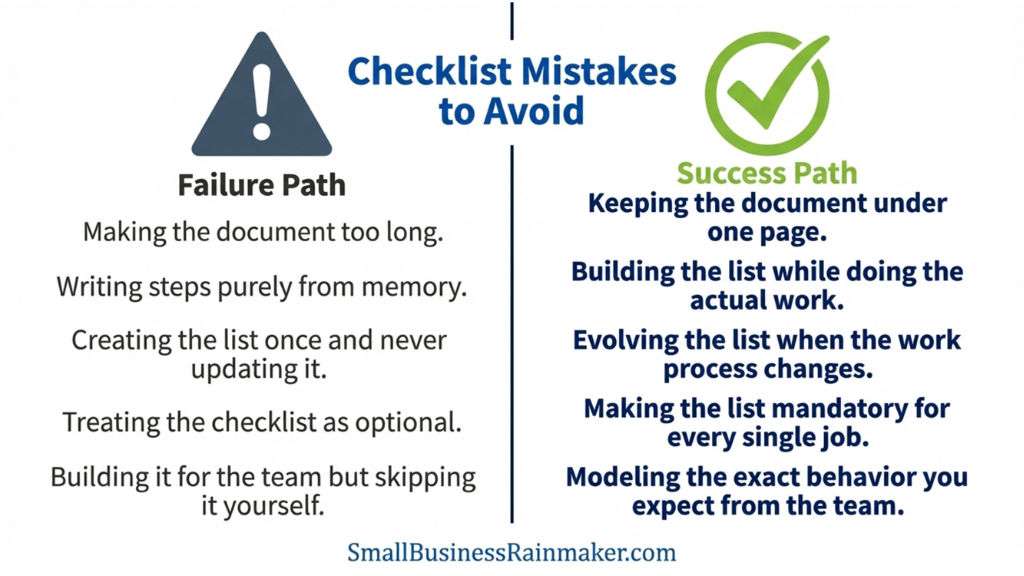
Making it too long. If your checklist takes longer to complete than the work itself, people will start skipping it. Keep it tight and focused on what genuinely matters.
Writing it from memory instead of testing it. Build the checklist while doing the actual work, not after the fact. You will catch things you would never think to include otherwise.
Creating it once and never touching it again. Your process evolves. Your checklist should evolve with it. Review it any time you find a recurring error or change how the work gets done.
Treating it as optional. A checklist only delivers consistent results if it is non-negotiable. Every job, every time. When exceptions start getting made, the standard disappears quickly.
Building it for your team but not using it yourself. If the owner skips the checklist, the team will too. Model the behavior you want to see.
How to Get Your Team to Actually Use It
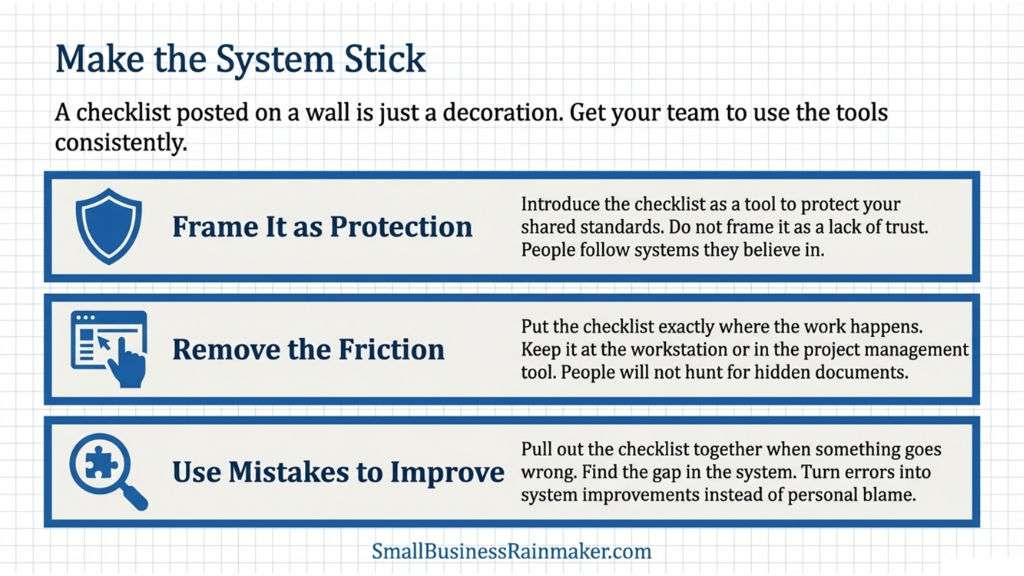
A checklist posted on a wall that nobody reads is not a quality system. It is a decoration. Getting your team to use a checklist consistently comes down to three things.
First, introduce it as a protection tool, not a monitoring tool. Frame it as this is how we protect our standards and our reputation, not as I do not trust you to remember. People follow systems they believe in. They resent ones that feel like surveillance.
Second, put it where the work happens. A checklist lives at the workstation, on the job order, in the project management tool your team already uses. If someone has to go looking for it, it won’t get used. Remove the friction entirely.
Third, use real mistakes to improve it in real time. When something goes wrong, pull out the checklist and ask together where the gap is. Add or revise the item that would have caught the problem. This keeps the checklist alive, shows the team it is a working document, and turns errors into improvements instead of blame.
Start With One Checklist Today
Companies don’t need a quality department to deliver consistent quality. They simply need a clear, documented picture of how good work gets done, written down in a format anyone can follow.
Two checklists cover the full picture. The process checklist guides the work as it happens and prevents problems from developing. The inspection checklist catches anything that slips through before it reaches your customer. Together, they give you a quality system that runs on process rather than luck.
Start with one product or service. Build the process checklist first. Test it on real work and refine it. Then build the inspection checklist and connect the two.
A checklist is one of the most powerful tools in business process management for small businesses. But it is just the starting point. Checklists are one piece of a broader system of documented, repeatable processes that allow your business to deliver consistent results whether you are doing the work yourself or building a team around you.
If you are ready to build that kind of system, Business Process Management for Small Businesses gives you the framework to document, manage, and continuously improve every core process in your business. Quality becomes a system, not a habit you have to remember.