Most small business owners dread customer complaints. The instinct is understandable. A complaint feels like a judgment, and when you’ve built something with real effort and care, criticism lands differently than it does in a large company where accountability is spread across departments.
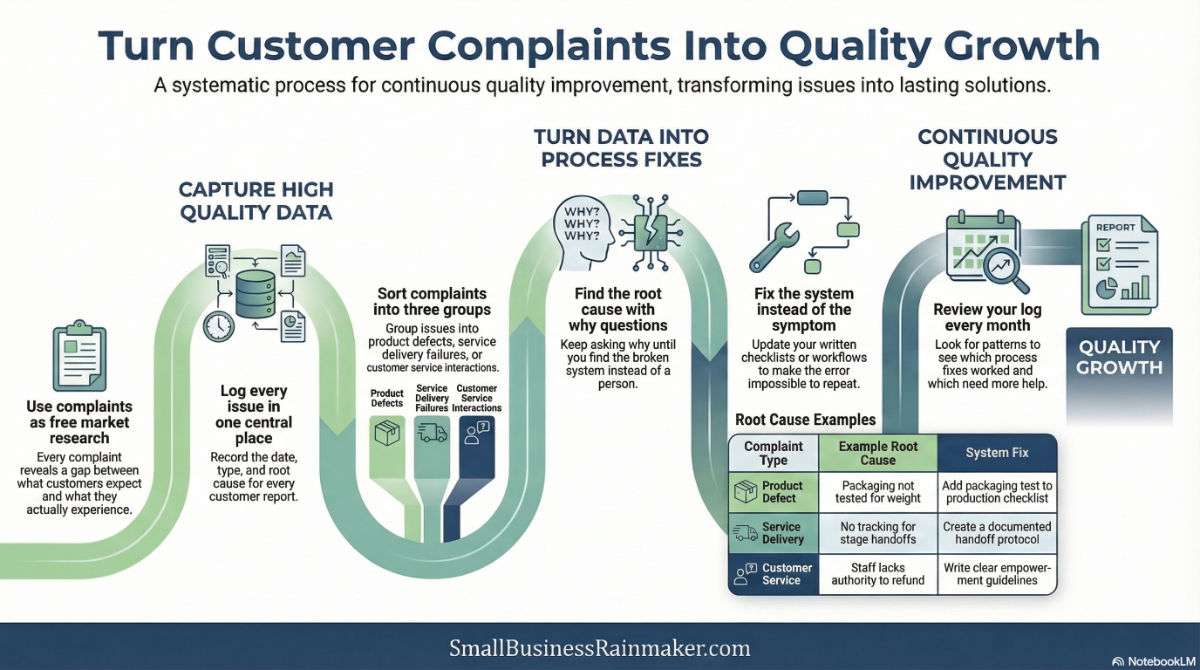
But the small business owners who improve fastest share a different instinct. They treat complaints as the most honest market research they will ever receive, and it arrives at no cost. Every complaint points directly at a gap between what the customer expected and what they actually experienced. That gap is information. Specific, actionable, free information.
The difference between a business that keeps making the same mistakes and one that gets measurably better over time is not talent or intention. Most business owners have both. The difference is whether complaints get resolved or whether they get used.
This article walks you through a practical system for capturing, categorizing, and acting on complaints in a way that produces real quality improvements over time. You build the system once. It pays you back every time a complaint comes in.
Table of contents
Why Most Small Companies Handle Complaints Wrong
The standard complaint response in a small company follows a predictable pattern. The customer reaches out. They apologize, fix the immediate problem, and move on. The customer is satisfied, or at least no longer upset. The complaint is considered closed.
What rarely happens is any investigation into why the problem occurred or whether it is likely to happen again. The complaint gets resolved but the cause never gets addressed. Two months later, a different customer has the same experience. The apology goes out again.
This is the most common yet most costly way to handle complaints. The business gets better at managing the fallout but never gets better at preventing the problem. The same issues cycle through the business indefinitely because no one ever connects them to a process that needs fixing.
The second failure is treating every complaint as an isolated incident. One complaint about a late delivery might genuinely be a fluke. Five complaints about late deliveries in a single month is a process problem. Without a record, you can’t tell the difference. Without a record, a pattern that should be obvious stays invisible.
Complaints are not customer service events. They are quality data. The goal is not just to resolve them, but to extract information about where your business is falling short and use that information to close the gap.
Build a Simple Complaint Log
Before you can find patterns, you need a record. Most small businesses have no central place where complaints are documented. They live in email threads, text messages, memory, and the occasional sticky note. That makes pattern recognition impossible.
A complaint log doesn’t need to be sophisticated. A shared spreadsheet is enough. What matters is that it captures the right information consistently every time a complaint comes in.
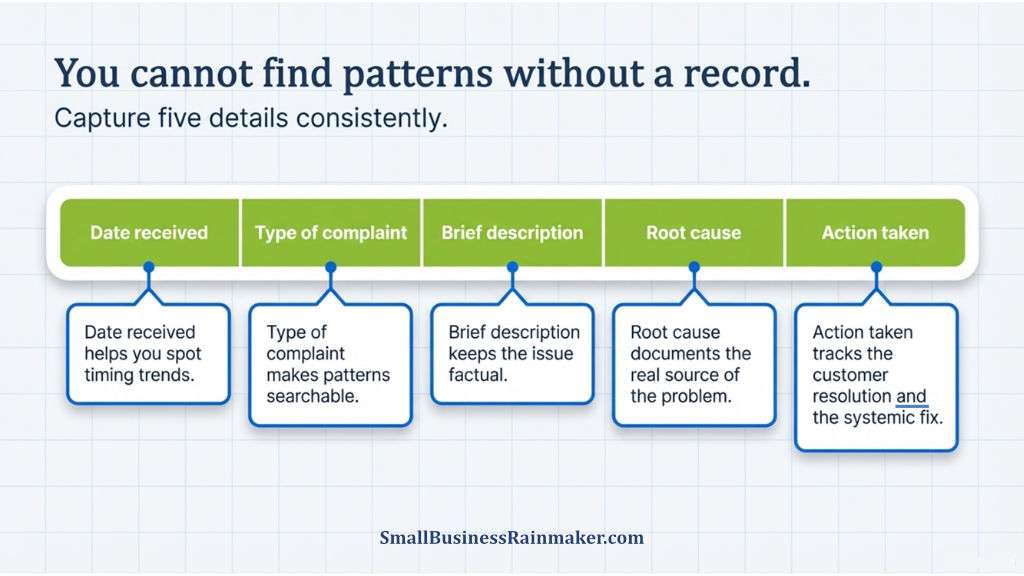
Five fields belong in every complaint log.
- Date received.
Patterns often have a timing component. A spike in complaints following a new supplier, a new team member, or a process change becomes visible when you can see dates.
- Type of complaint.
Categorize each complaint as a product defect, a service delivery failure, or a customer service interaction. This categorization is what makes patterns searchable later.
- Brief description.
What did the customer report, in plain language. Keep it factual and specific. Not “customer unhappy” but “customer received wrong item, ordered blue, received green.”
- Root cause once investigated.
What actually caused the problem after you traced it back? This field gets filled in after the investigation, not at the time of the complaint.
- Action taken.
How the complaint was resolved for the customer and whether a process change was made as a result. Both matter. The customer resolution and the systemic fix are two different things.
The root cause and action taken fields are the ones that transform a complaint log from a record of problems into a quality improvement tool. Without them, you have documentation. With them, you have intelligence.
The mechanics are simple. Whoever handles the complaint logs it before closing it. The owner or manager reviews the full log on a regular schedule, weekly if complaint volume is high, monthly if it is lower.
Categorize Complaints to Find the Patterns
Raw complaints are noise. Categorized complaints are intelligence. The three complaint categories each point to different parts of your business when they start repeating.
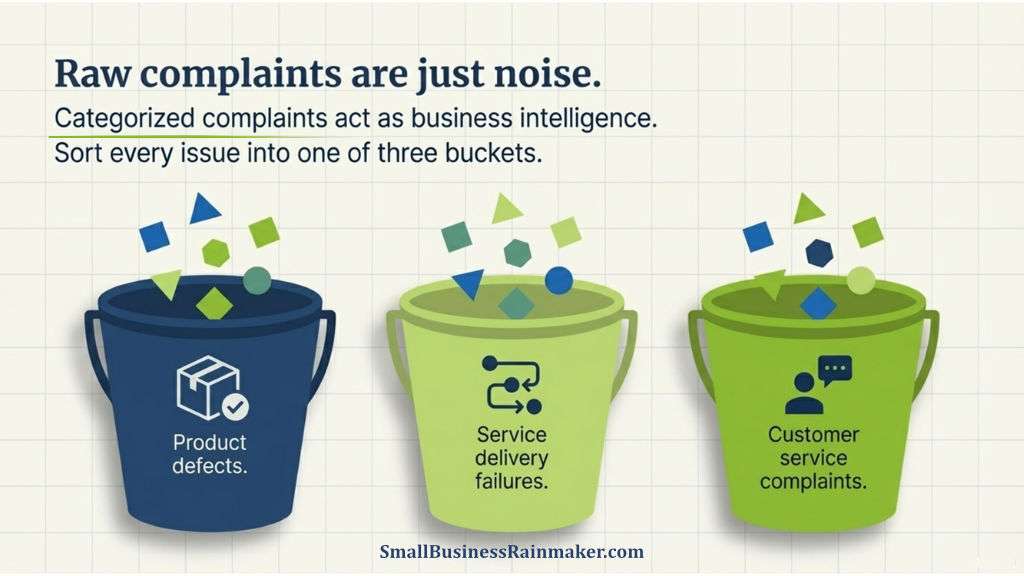
Product defects are complaints about the physical product itself. Something arrived broken, failed sooner than expected, did not work as described, or did not match what was ordered. When product defect complaints repeat with the same root cause, they almost always point to an upstream process failure. A production step that is inconsistent, a material or supplier that does not meet spec, a QC checkpoint that is missing or not being used. The defect shows up at the customer end, but the cause is earlier in the chain.
Service delivery failures are complaints about how the work was executed or delivered. This could be a missed deadline, an order fulfilled incorrectly, or a project delivered incomplete. These complaints tend to point to gaps in workflow, communication, or the hand-offs between people or stages in your process. When the same type of service failure keeps appearing, something in how the work moves through your business is broken.
Customer service complaints are about the experience of getting help, not the original problem itself. A customer felt dismissed, did not hear back quickly enough, was passed around without resolution, or received an inconsistent answer depending on who they spoke to. These complaints point to training gaps, unclear protocols, or situations where team members did not have the authority or guidance to resolve the issue efficiently.
Build this habit into your monthly log review. Sort the complaints by type. Look for any category where the same root cause appears more than once. That repetition is your next process improvement priority.
| One complaint might be a bad day. The same complaint three times is a broken process. |
Trace Every Complaint Back to Its Root Cause
Resolving a complaint fixes the customer relationship and it’s natural keep that a high priority. Finding the root cause fixes the business. These are two separate steps, and most businesses only take the first one.
The most practical tool for finding root causes is also the simplest one. When a complaint comes in, ask the staff why it happened. Then ask why that happened. Keep asking why until you reach the actual source of the problem rather than just the symptom it produced. Most quality problems reach their root cause within four or five of these questions.
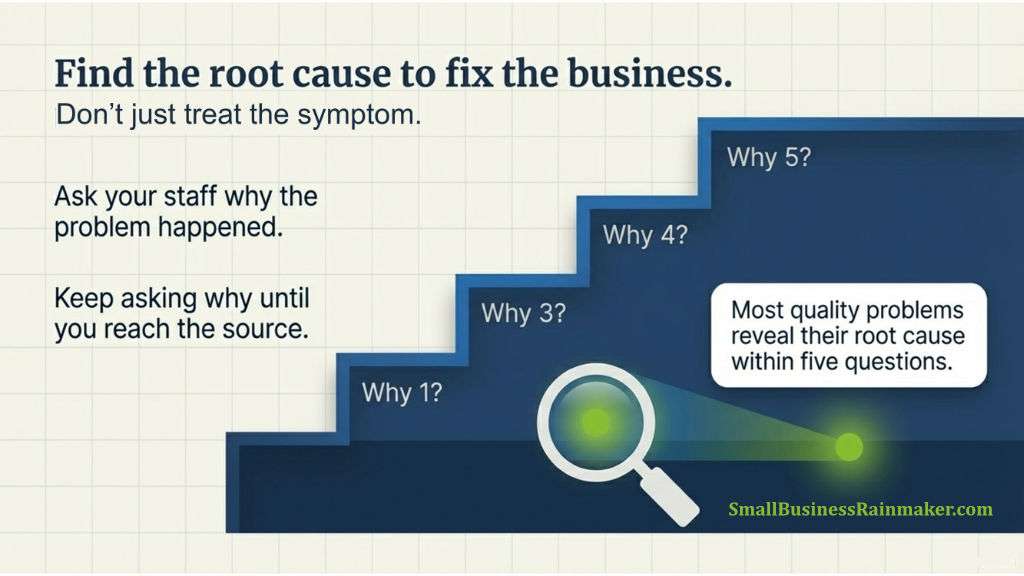
Here’s what this process looks like across each complaint type.
A customer receives a damaged product. Why? It arrived broken in the box. Why? The packaging failed during transit. Why? The packaging was not tested for the weight of this specific product. Why? There was no packaging test step in the production process for this item. The root cause is not a rough handling incident by a shipping carrier. It is a missing process step that left the product vulnerable before it was ever picked up.
A project is delivered late. Why? The final stage ran over schedule. Why? A dependency from the previous stage arrived late. Why? No one was tracking the hand-off deadline between stages. Why? There is no documented hand-off protocol in the workflow. The root cause is not that someone was slow. It is that no system existed to flag the delay before it compounded.
A customer complains about feeling dismissed when they reached out for help. Why? The team member offered a refund and closed the ticket. Why? That was the only resolution option they knew they were authorized to offer. Why? No one had defined what resolutions team members could make independently versus what required escalation. The root cause is not an uncaring employee. It is an absence of clear empowerment guidelines.
The root cause in each case is a process gap. It’s not a people problem, not bad luck, not an unusual situation. A step that was missing, a standard that was not defined, or a system that did not exist. Those are all fixable.
Turn the Root Cause into a Process Fix
A root cause finding that does not lead to a documented change is just an interesting observation. The investigation only delivers value when it produces a concrete fix that gets built into how the work actually gets done going forward.
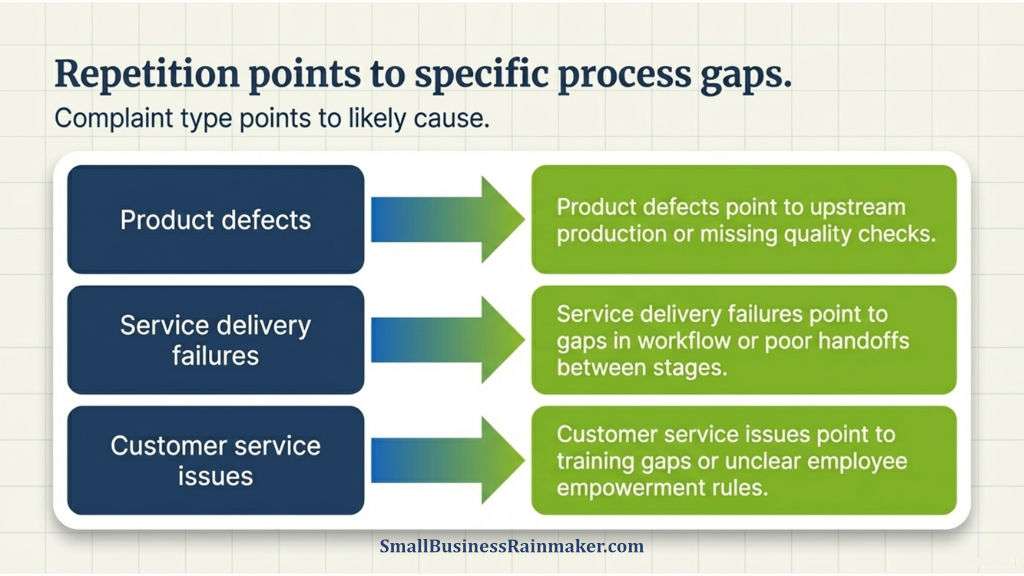
Match the fix to the complaint type.
For product defects.
Add or revise a step in your production process or QC checklist. If the fix is a new inspection point, write it into the checklist and make it a required step on every run. If the fix is a supplier change or a material specification, document that standard so anyone sourcing materials in the future knows what the requirement is.
For service delivery failures.
Add a handoff checkpoint, a deadline tracker, or a communication step to the relevant workflow. The best process fix makes the failure mode structurally difficult to repeat, not just less likely if everyone remembers to be careful. A step written into the workflow does not depend on anyone’s memory.
For customer service complaints.
Update your team guidelines. Write down what resolutions team members are authorized to offer without escalation, what situations require a manager, and what the response time standard is for each type of complaint. People handle customer issues better when they know exactly what they are empowered to do.
A process fix isn’t complete until it’s written down and incorporated into how the work gets done. Telling the team about a new approach in a meeting is not a process fix. It is a conversation that will fade. An updated checklist, a revised workflow, or an amended set of guidelines is a process fix. It exists outside of anyone’s memory.
Make the Review a Habit
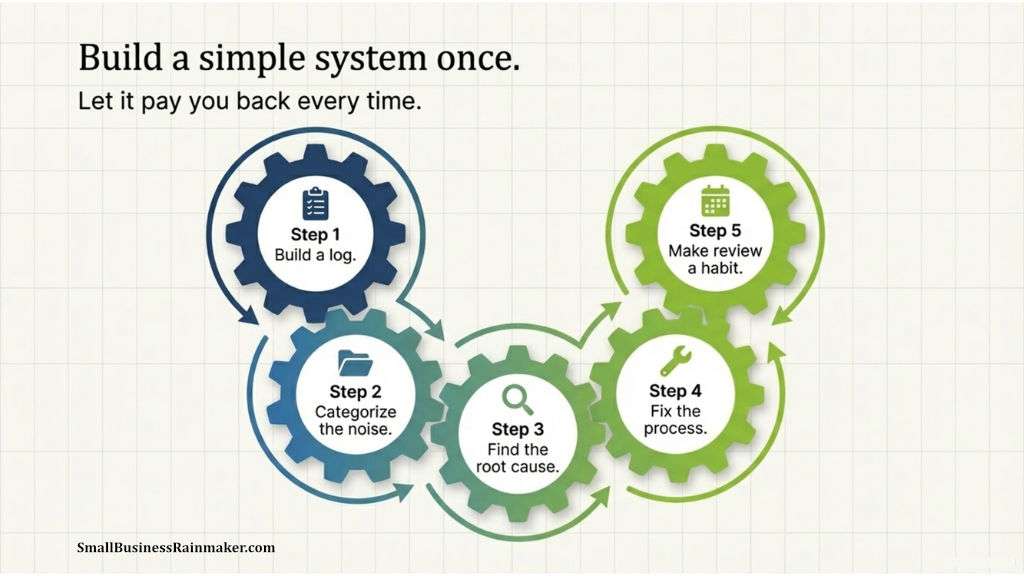
A complaint log becomes a quality improvement system when it is reviewed on a regular schedule. Without the review, the log is just a record of things that went wrong.
Build a simple review rhythm into your operations. Review individual complaints as they come in so they get resolved promptly and logged accurately. Review the full log at the end of each month to look for patterns across complaint types and root causes. Do a deeper review quarterly to assess whether the process fixes you made in previous months actually reduced complaint volume in those categories.
The monthly pattern review does not need to take long. Fifteen minutes with the complaint log at the end of each month is enough to catch a repeating problem before it compounds into something more costly to address.
If you have a team, make the monthly review a brief group conversation rather than something you do alone. The people who handle complaints every day often have pattern recognition that never surfaces in a formal setting. They know which types of problems are showing up most often. They have theories about why. That knowledge belongs in the conversation where decisions get made.
Over time, a consistent review habit produces something valuable beyond the individual fixes it generates. It builds a record of how your business has improved. You can see complaint volume by category trending down. You can see which process fixes worked and which ones need another pass. You can see the business getting better in a way that is documented and measurable.
Your Complaints Are Trying to Help You
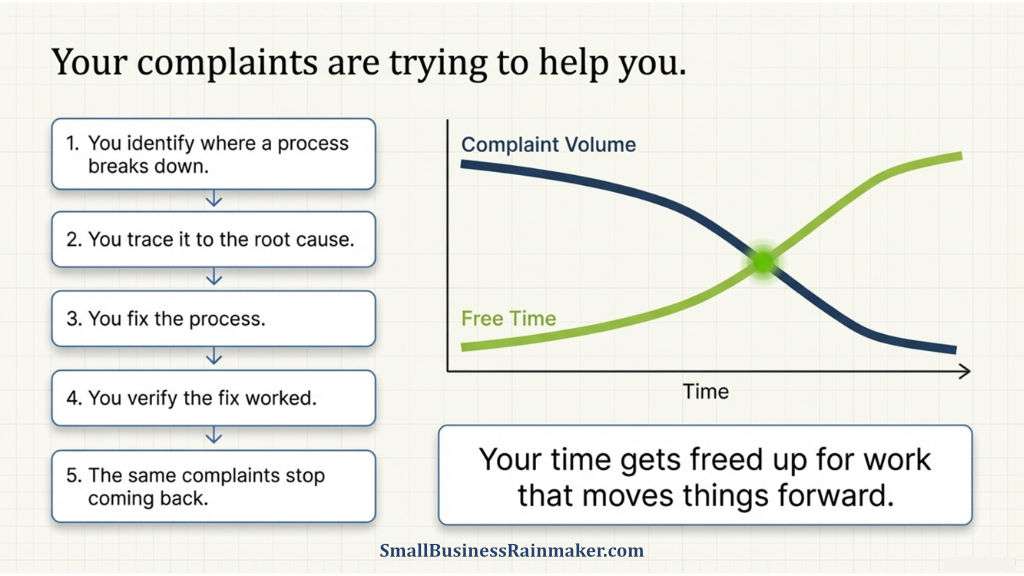
A business that resolves complaints and forgets them stays at the same level of quality indefinitely. A business that logs them, categorizes them, traces them to root causes, fixes the underlying process, and reviews the results regularly gets measurably better over time. The same complaints stop coming back. New problems get caught and addressed faster. Quality improves not because everyone is trying harder but because the system is designed to learn.
The system itself is not complicated. A complaint log with five fields. A monthly review to find the patterns. A root cause question applied to every recurring problem. A process fix that gets written down. A quarterly check to see if the fix worked.
Any small business can build this today. The investment is small, especially when compared to the potential costs of recurring problems. The return compounds every month as the same problems stop cycling through your business and your time gets freed up for work that actually moves things forward.
This complaint-to-improvement loop is one of the clearest examples of business process management working in practice. You identify where a process breaks down, trace it to the root cause, fix the process, and verify the fix worked. That cycle of continuous improvement is exactly what business process management (BPM) is built to support.
If you are ready to build that kind of system across your entire business, Business Process Management for Small Businesses gives you the framework to document your processes, find where they break down, and improve them in a way that sticks.