
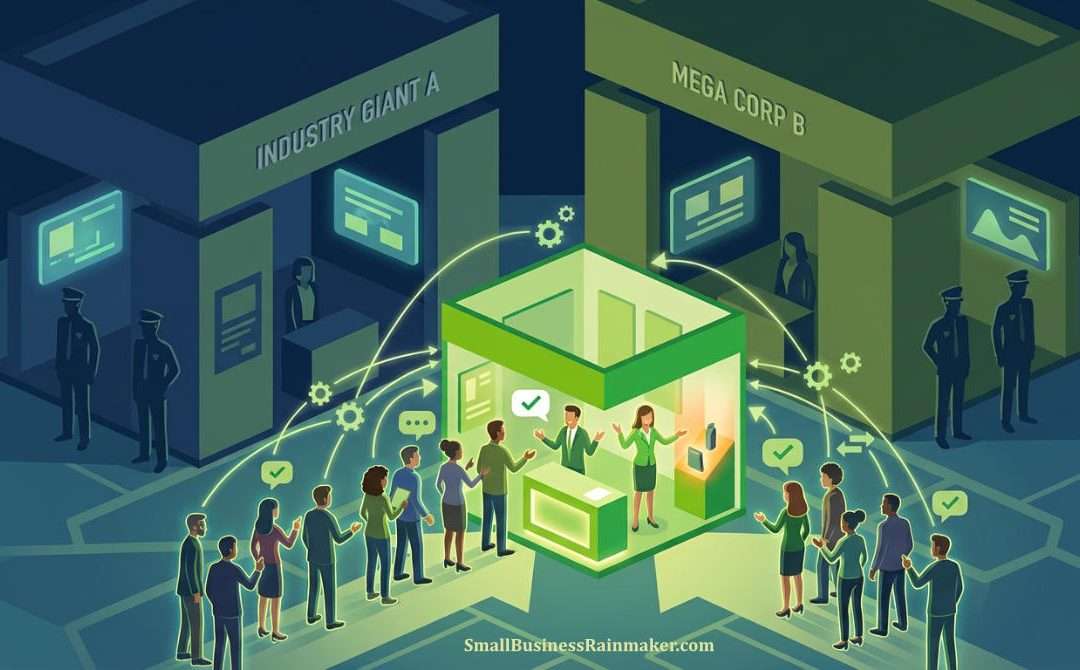
Walk into any major industry trade show and the first thing you notice is the big booths. Giant backlit displays, matching staff uniforms, branded giveaway bags, and product demo stations that look like they cost more than your annual marketing budget. It is easy to look at all of that and conclude, “This is not for us.”
The fact is that trade shows are not just for big companies. Small companies miss real opportunities every year by thinking they’re too small for the trade show floor.
Trade shows are one of the few marketing channels where small companies can stand next to industry giants, talk directly to qualified buyers, and walk away with leads that would take months to generate any other way. The key is approaching the show with a plan that fits your size and uses it as a strength rather than an apology.
This article breaks down why trade shows deserve a place in your marketing mix, how to choose the right show, and what to do before, during, and after to get a real return on your investment.
Table of contents
- The Misconceptions That Keep Small Businesses Away
- The Advantages Small Businesses Actually Bring to the Floor
- Choose the Right Show Before You Spend a Dollar
- Set Goals That Reflect How Trade Shows Actually Work
- Budget-Smart Strategies That Still Look Professional
- Your Booth Is a Sales Environment: Design It That Way
- Go Beyond the Booth During Show Hours
- The Follow-Up Is Where the Money Lives
- Your Next Step and a Trade Show Checklist
- Friction Points for Trade Show Attendees [Infographic]
The Misconceptions That Keep Small Businesses Away
Most small business owners share a handful of reasons for skipping trade shows. The costs are too high. The competition is too big. The ROI is too uncertain. These concerns are real, but they rest on assumptions that fall apart when you examine them closely.
The cost concern is the most common. Yes, exhibiting at a major national trade show can run into tens of thousands of dollars when you factor in booth space, travel, lodging, display materials, and staff time. But regional shows and niche industry events cost a fraction of that. A well-prepared 10×10 booth at the right regional show can generate more qualified leads than a 20×30 corner booth at a show that does not match your audience. Cost is a factor, but it’s not the whole story.
The competition concern fades when you consider what trade show attendees actually do. They don’t walk the floor looking for the biggest booth. They walk the floor looking for solutions to specific problems. A buyer with a need for your product will stop at your booth regardless of whether you have a 10×10 or a 10×30. Your job is to be there, be clear, and be ready to have a real conversation.
The Advantages Small Businesses Actually Bring to the Floor
One thing that does not get said enough is that small companies carry genuine advantages at trade shows that large companies cannot replicate.
When someone visits a large company booth, they talk to a sales rep. That rep collects their information and passes it up a chain before anything happens. When someone visits your booth, they often talk directly to the owner, the founder, or the person who makes decisions. That conversation carries a different weight. It builds trust faster. It leads to faster follow-up. And it leaves a lasting impression because the person they spoke with genuinely knew the product and cared about the outcome.
Small businesses also tell better stories. You built something. You know every detail of your product or service because you live it. That authenticity comes through in conversations, and it is something polished corporate messaging cannot match. A buyer who feels like they connected with a real person will remember you far longer than a slick brand display.
You also move faster. A large company needs approval chains to change pricing, customize an offer, or commit to a timeline. You can make a decision on the spot. In a fast-moving sales environment, that speed is a genuine competitive edge.
Choose the Right Show Before You Spend a Dollar
Not every trade show justifies the investment. Choosing the wrong show is the most common reason small businesses walk away disappointed and conclude that trade shows do not work. They do work, but only when the audience matches your customer profile.
Start with your customer. Who are you trying to reach? What industry do they work in? What associations do they belong to? What events do they attend? Answer those questions and then research the shows where your ideal buyer shows up as an attendee, not just an exhibitor.
Compare attendee volume to exhibitor cost. A smaller show with 800 highly qualified attendees will almost always outperform a massive show with 15,000 attendees who have no need for your product. Niche shows and regional events are often undervalued by small businesses for exactly this reason.
If you’ve never attended a show in your target industry, think about walking the floor as a visitor before committing to exhibit. Spend one show observing the traffic patterns, the buyer types, the competitor booths, and the conversations happening on the floor. That single visit can save you thousands of dollars by confirming whether the show deserves your exhibit investment.
Set Goals That Reflect How Trade Shows Actually Work
The biggest mistake small businesses make is expecting to close sales on the show floor. It happens occasionally, but trade shows are not primarily a direct sales channel. They are a relationship-building and lead generation channel. If you walk in expecting to write orders, you will likely leave disappointed. If you walk in with the right goals, you’ll leave with a full pipeline.
Define your goals before the show. Realistic targets include:
- the number of qualified conversations you want to have each day,
- the number of leads you want to capture,
- the number of specific prospects you want to connect with by name,
- and the competitive intelligence you want to gather by observing other exhibitors.
These goals give you a clear way to measure success beyond the vague sense of whether the show felt good. Write them down, share them with your booth staff, and review them each evening during the show.
Budget-Smart Strategies That Still Look Professional

You don’t need a large budget to show up professionally. You need a focused budget and smart decisions. The first show I ever did consisted of a table and two posters. We made our first sale in the first ten minutes of the show. It was the last one we made at the show, but the follow-up campaign gave us plenty of sales and a healthy return on investment.
Rent display materials for your first show rather than buying them outright. This reduces upfront cost and lets you test formats before committing to a permanent setup. Portable banner stands, modular pop-up displays, and tabletop setups travel well and set up in minutes without a professional crew.
Spend your giveaway budget on items that connect directly to your business rather than generic promotional products. A useful tool, a resource guide, or a compelling offer redeemable after the show will always outperform a stress ball or a branded pen. Your giveaway should start a conversation, not end one.
Use pre-show marketing to drive traffic to your booth. Email your existing contacts and prospects before the show. Post on social media. If the show provides an exhibitor directory or app, make sure your listing is complete and includes your booth number. Many attendees plan their floor visits in advance. Reach them before they arrive.
Finally, look into shared booth opportunities. Some industry associations run pavilions where multiple small companies exhibit together at a reduced cost. This lowers your entry point and still puts you in front of the right audience.
Trade Show Budget Planner

We created a trade show budget planner for small companies. It’s helpful for planning your first or your fortieth show.
Once you complete the planner the first time, you have a foundation for improving ROI on all future shows.
Download the Trade Show Budget Planner here.
Note: The planner is an Excel file in .xlsx format and clicking the link will ask you to either open it in Excel or download the Excel file to your computer.
Your Booth Is a Sales Environment: Design It That Way
The way you set up your booth directly affects how many people stop, engage, and leave with a positive impression. Trade show floor traffic moves fast. Attendees scan, decide, and act within seconds. A poorly designed booth creates what booth design specialists call friction points, small moments of confusion or hesitation that cause visitors to walk past even when they might have had genuine interest.
The infographic from Empyre Talent (scroll to bottom) identifies several key causes of booth friction that small exhibitors can easily fix. Entry points that are not clearly defined, signage that requires too much effort to read, and layouts that feel crowded all reduce the number of visitors who actually step in.
The same guide maps the visitor experience across four moments:
- the Welcome Point
- the Engagement Point
- the Transition Point and
- the Exit or Next Step
At the Welcome Point, a warm greeting signals that the booth is open and approachable. At the Engagement Point, staff positioned at natural pause areas such as demo zones use open posture and eye contact to invite visitors in without pressure. If you don’t have extra staff, it’s easy to hire trade show models and assistants to help with customer greeting. At the Transition Point, simple directional cues such as a gesture or a phrase like “Let me show you this” keep momentum going. At the Exit or Next Step, a closing prompt such as “Feel free to try this next” keeps the experience moving rather than letting it stall.
The core principle behind all of this is that clarity drives movement. When visitors feel uncertain about where to go or what to do, they move on. When the path through your booth is obvious and your staff creates a welcoming flow, visitors stay longer and engage more deeply. For a small business with limited floor space, this human flow approach delivers an outsized return because every conversation matters.
Go Beyond the Booth During Show Hours
Your time at the show is worth more than the hours you spend behind your table. Trade shows pack networking events, educational sessions, keynote presentations, and informal gatherings into a short window. Use all of it.
Attend sessions where your target customers show up as audience members. Sit next to them. Start conversations. Introduce yourself not as an exhibitor but as someone interested in the same industry challenges they face. Some of your most valuable connections at a trade show will happen in a conference room or at a networking lunch, reception, or dinner rather than on the show floor.
The show also gives you real content to share. Take photos. Capture short videos. Post to your social media channels in real time. Share insights from sessions you attend. This activity extends your reach to people who are not at the show while signaling to your existing audience that you are active and engaged in your industry.
If you have clients coming to your booth (and you should), ask them if you can record a testimonial video. It doesn’t have to be professionally polished and edited. Prompt them with questions to get them started.
“Tell us about the challenge we helped you overcome.”
“What kind of ROI did you get using our product/service?”
The Follow-Up Is Where the Money Lives

Here is the reality that most trade show exhibitors miss: the ROI from a trade show happens after the show ends. The conversations on the floor plant the seeds. The follow-up is where they grow.
Follow up within 48 to 72 hours while the memory of the conversation is still fresh for both you and your prospect. Reference something specific from your conversation so the person knows you were genuinely paying attention. A follow-up that says “Great to meet you, hope you enjoyed the show” is forgotten instantly. A follow-up that says “You mentioned you were struggling with X, here is something that might help” gets opened and acted on.
Segment your leads before you reach out. Not every contact you made carries the same potential. Prioritize your follow-up list by buying intent. The people who asked specific questions about pricing, timelines, or next steps go to the top. Warm connections who expressed general interest follow. Collect everyone on LinkedIn within 24 hours of the conversation ending.
Once the initial hot follow up is done, there should be an extended direct mail and email sequence ready to go to all prospects that haven’t purchased. Depending on the lifetime value of your clients, these followup sequences should go on for months.
Most trade shows offer electronic lead collection machines or apps you can use on your phone or laptop. They instantly scan badges to collect complete visitor details. These can be used to organize and segment your contacts once they’re scanned in. You can also export the list to your contact management system after the show.
Some visitors will still use business cards. Be sure to collect them all and enter them in your database with relevant notes on the conversation you had with them.
Companies that follow up consistently and personally convert a trade show into a significant pipeline generator. Companies that do not follow up waste every dollar they spent getting there.
It’s important to have a regular newsletter that goes out to these new leads (as well as all your clients and other prospects.) At the very minimum, an email newsletter is needed. Ideally, a monthly or quarterly print newsletter is important. Printed newsletters stand out and get retained far more than email. And newsletters can be sent to prospects for years to come. In fact, we had one prospect who became a client after 12 years of receiving our monthly newsletter, another one at 10 years…crazy but true!
Your Next Step and a Trade Show Checklist
Trade shows reward companies that show up prepared, that engage authentically, and that follow through consistently. None of those qualities require a large budget or a large company. They require clarity about who you serve, a plan that fits your resources, and the discipline to execute before, during, and after the show.
Start small. Identify one show in your industry that attracts your ideal buyer. Research the exhibitor cost, the attendee profile, and the past exhibitor list. If the numbers and the audience line up, commit to a 10×10 booth and treat every element of the experience as a learning opportunity. Your first show teaches you more than any article can.
The companies on that show floor that look intimidating? They started exactly where you are. The difference is they showed up.
Download our Trade Show Checklist here to be sure you’re not missing important elements.
Download the Trade Show Budget Planner here.
If you’d like help with planning and executing a trade show, send us a message here with some information about your show.
Friction Points for Trade Show Attendees [Infographic]


